Understanding Diamonds
Choosing a diamond involves understanding what defines its beauty: the carat, color, clarity, and cut — the famous 4 Cs. This guide provides you with the essentials, simply, to choose your engagement ring with confidence.
The 4 Cs: The Universal Language of Diamonds
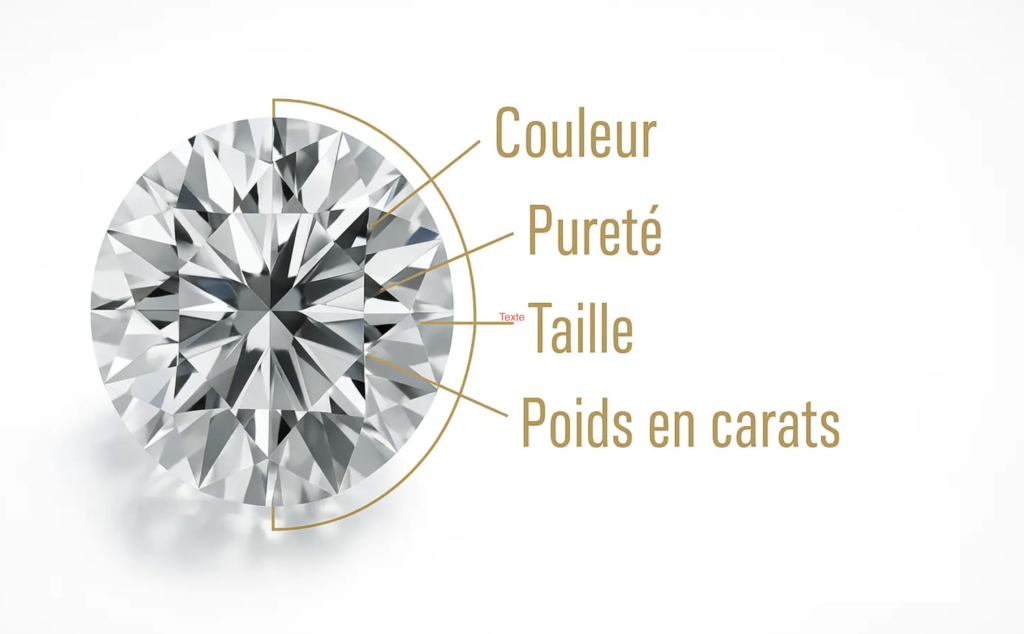
Worldwide, a diamond is evaluated according to four criteria: carat, color, clarity, and cut — in English, Carat, Colour, Clarity, Cut, hence the expression “4 Cs.” This framework, formalized by the Gemological Institute of America (GIA), allows for an objective description of a stone and an understanding of its value. None of these criteria is sufficient on its own: their balance determines a diamond's character and price. Two stones of the same weight can thus vary in value from single to triple depending on their color, clarity, and cut quality. Knowing the 4 Cs empowers you to make an informed choice rather than relying solely on impression.
Carat: Weight and Presence
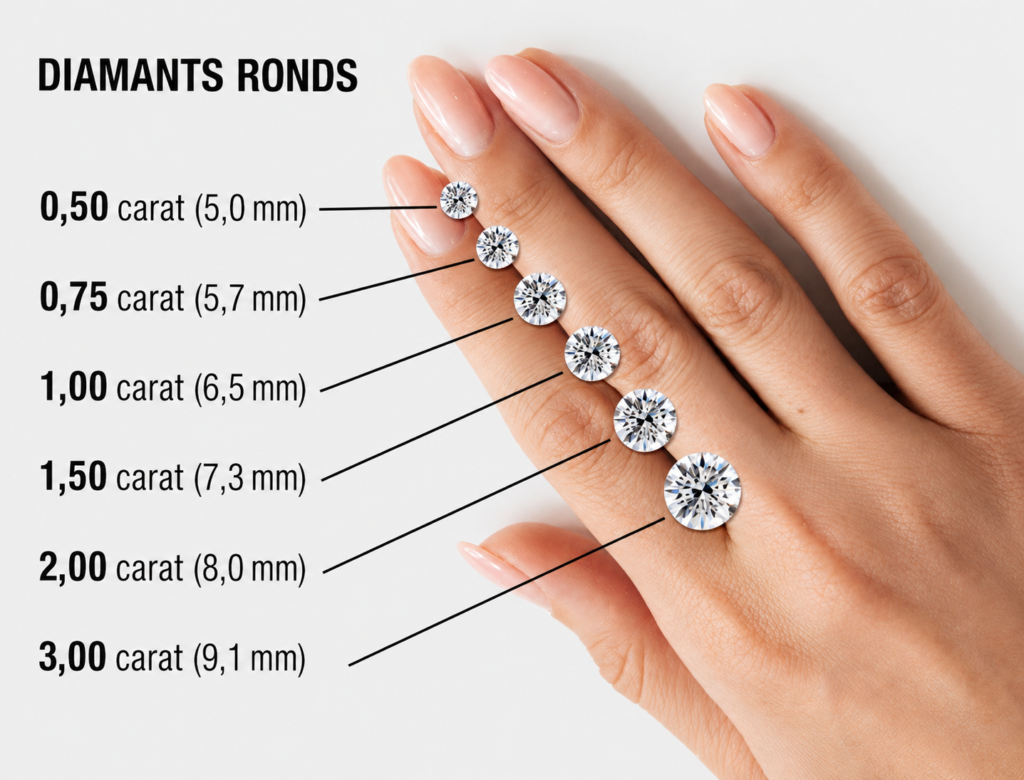
Carat measures a diamond's weight: one carat is equivalent to 0.20 grams, which is itself divided into one hundred points (a 0.50 ct diamond therefore weighs 50 points). Contrary to popular belief, carat does not refer to visible size but rather to the stone's mass. Its price increases exponentially: as heavier diamonds are much rarer, a 2-carat stone costs significantly more than two 1-carat stones. This is why 'round' weights (1 ct, 1.50 ct, 2 ct) are priced higher than slightly lower weights, despite having an almost identical appearance. Choosing the right carat means finding the perfect balance between the stone's presence and your budget.
Color: The Quest for Transparency
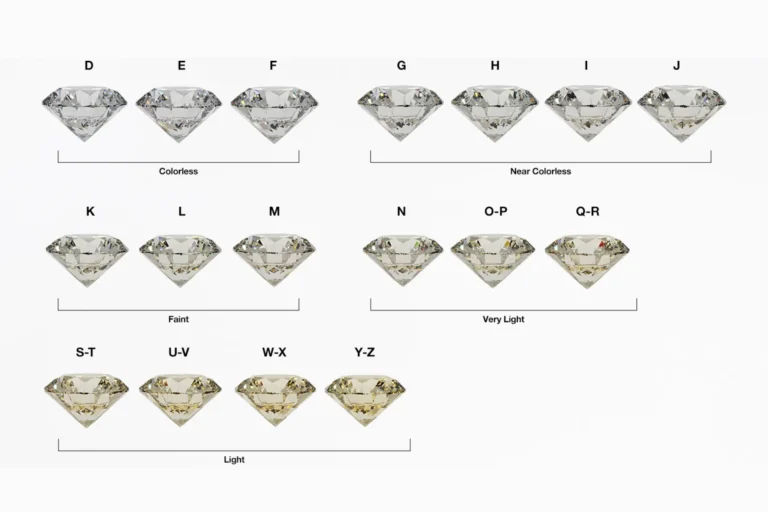
A diamond's color is graded on a scale from letter D (perfectly colorless) to Z (perceptible yellow or brown tint). The most sought-after stones, graded D to F, are absolutely transparent and the most valuable. Grades G to J, known as 'near colorless,' offer an excellent balance between beauty and price: the slight tint remains invisible to the naked eye, especially once the stone is set. The choice of metal also plays a role: white gold or platinum enhances a very white stone, while yellow or rose gold perfectly complements a slightly lower color grade. There are also so-called 'fancy color' diamonds — intense blues, pinks, yellows — which follow an inverse logic of rarity.
Clarity: Rarity in its Natural State
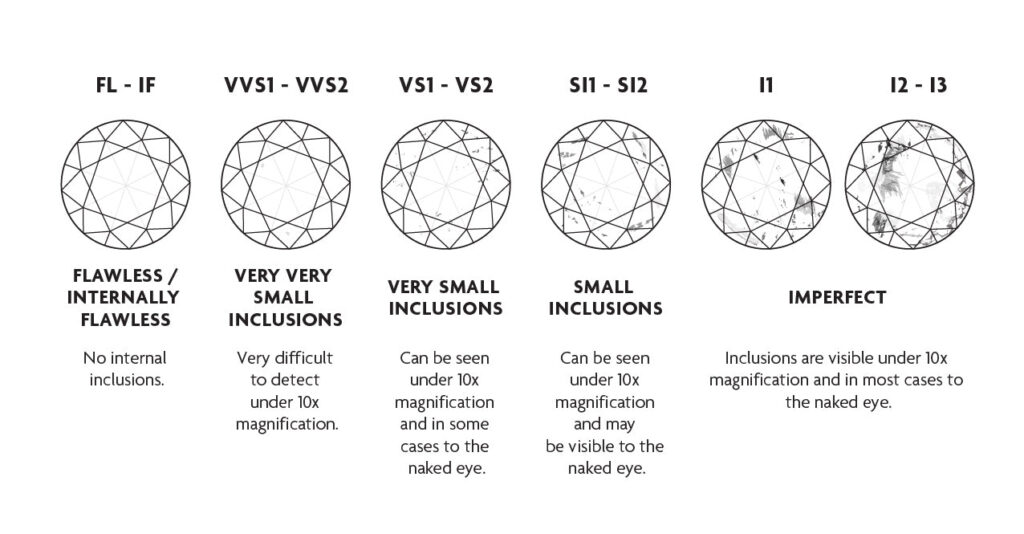
Formed billions of years ago under extreme pressure, almost all diamonds bear tiny internal marks, called inclusions. Clarity measures their number, size, and location, on a scale ranging from FL (Flawless, no inclusions) to I3 (inclusions visible to the naked eye). Between these extremes, VVS and VS grades exhibit inclusions so fine that they only appear under a microscope. For most buyers, a diamond considered 'eye-clean' — typically VS1, VS2, or SI1 — represents the best compromise: its beauty is intact to the naked eye, without paying the price for invisible perfection. Since each inclusion is unique, clarity also reminds us that every diamond is a singular stone.
Cut: The Art of Revealing Light
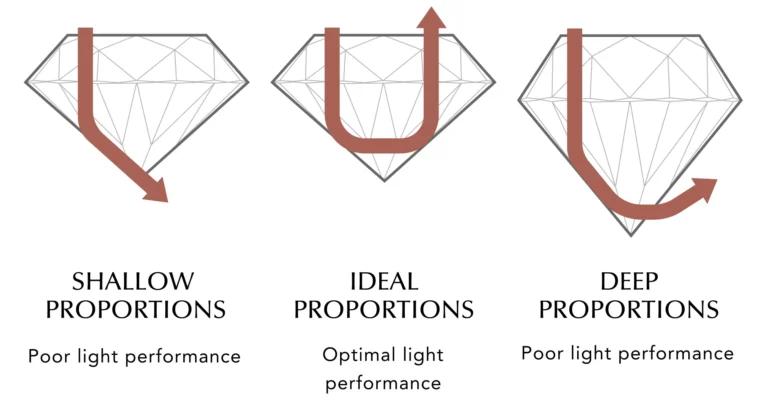
Cut does not refer to the shape (round, oval, princess…) but to the quality of the lapidary's work: proportions, symmetry, and polish. It determines how light enters and reflects within the stone, giving rise to brilliance, fire (colored flashes), and scintillation. Graded from Excellent to Poor, cut is often considered the most important of the 4 Cs, as a poorly cut diamond will appear dull regardless of its color and clarity. Conversely, an excellent cut can make a stone of more modest qualities sparkle. The round brilliant cut, with its fifty-seven facets, remains the benchmark for maximizing brilliance.
Certification: The Guarantee of Authenticity
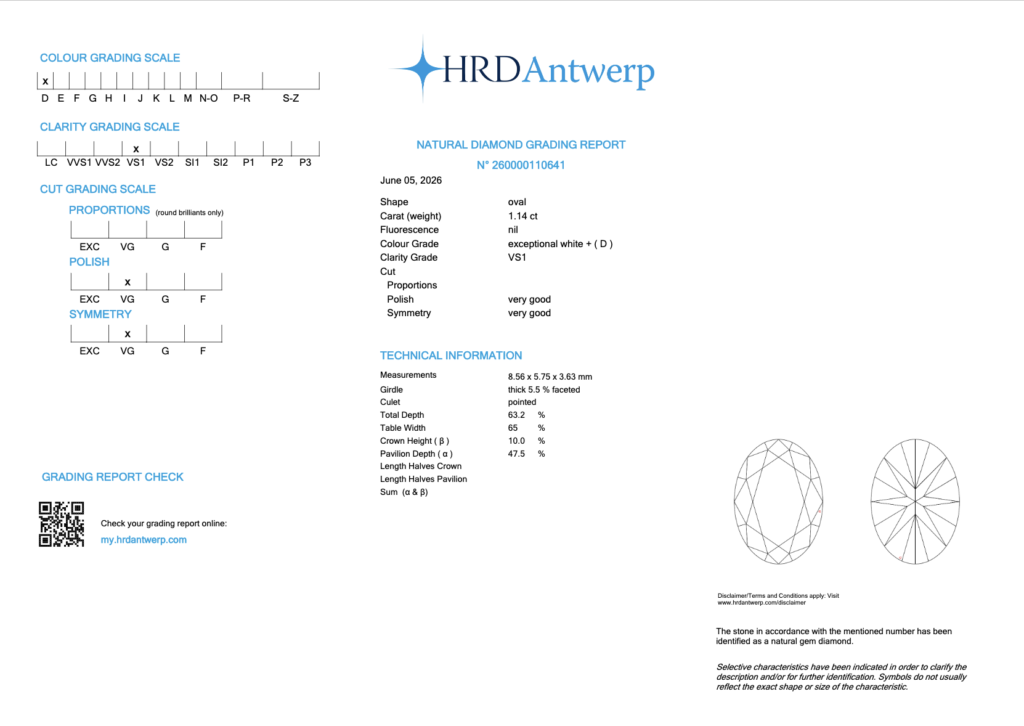
A valuable diamond comes with a certificate issued by an independent gemological laboratory — GIA, IGI, or HRD are among the most recognized. This document analyzes the stone according to the 4 Cs and records its exact characteristics, offering an objective evaluation on which buyer and seller can agree. Buying a certified diamond provides certainty that you are getting what you pay for, and a reliable reference for resale or insurance. The certificate also contributes to the stone's traceability, at a time when the ethical origin of diamonds (Kimberley Process, lab-grown diamonds) is becoming a selection criterion in its own right. In short, it transforms a beautiful promise into a written guarantee.


